
Every organization we link to: local tourism offices, the state and federal agencies that manage the land, the nonprofits and clubs that keep access open, and the universities doing the research.
West Virginia has roughly 1.5 million acres of public land and a handful of places that carry almost all of the attention. The consequence is that a great deal of very good ground sits nearly empty, usually for one of three reasons: nobody has heard of it, the road in is gated or rough, or it is undeveloped and has nothing to advertise. Those are the places below — of them across regions.
Almost Heaven Swings
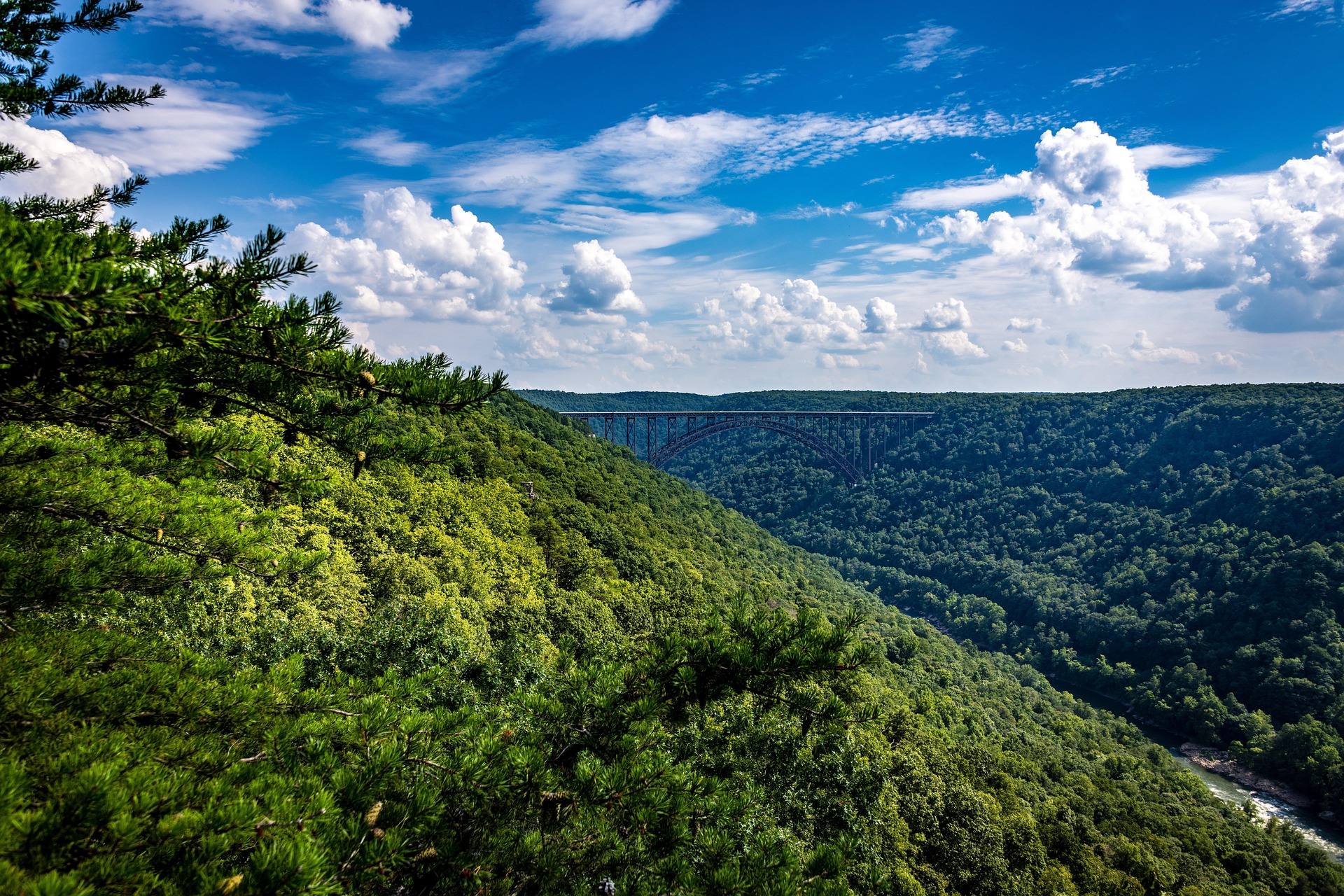
The window opens twelve months out
Cabin bookings in the West Virginia state park system open a year in advance. That is the figure the question wants, and it is the one to plan from: count back twelve months from the nights you want, and be ready on that date rather than checking casually in spring.
The popular parks fill within days of opening. Babcock, Blackwater Falls, Watoga and Cacapon routinely go for summer weekends and for the whole of October almost as soon as the window opens. At those four, being early on the day the calendar opens is the difference between a cabin and a campsite.
Campgrounds run on the same clock. State park and state forest campgrounds reserve through the West Virginia State Parks system, generally up to a year ahead, so a campsite is the same exercise with more inventory behind it.
Why October is the hardest month to get
Fall color starts on the highest ridges in late September and moves downhill through late October, reaching the Ohio Valley last. September and October are the busiest weeks of the year statewide, and lodging in Fayetteville, Davis and Marlinton books months ahead regardless of what the parks do.
Summer weekends are the other pressure point, for a different reason. Below 2,500 feet July and August are humid and hot, which pushes people up into the mountains where most of the cabins are. A Tuesday in July is a far easier booking than a Saturday in October.
The easy windows are the ones with fewer people in them. November and December empty the trails out, leaves come down and views open up, and a heated cabin makes a reasonable base. Anyone walking public land outside state parks in those months should wear blaze orange, because hunting seasons dominate.
A cabin is not one product
More than ten parks rent cabins and the range inside that number is wide. Much of the system was built by the Civilian Conservation Corps between 1933 and 1942, and the timber cabins and stonework at Watoga, Babcock, Lost River, Cabwaylingo and Greenbrier are still rented today.
At the other end, Kumbrabow and Seneca state forests rent cabins with no electricity, and Calvin Price State Forest has no facilities at all. Ten parks instead run full lodges with restaurants: Pipestem, Canaan Valley, Blackwater Falls, Cacapon, Twin Falls, Hawks Nest, North Bend, Tygart Lake, Stonewall Jackson and Chief Logan. Pipestem's operation includes a lodge reachable only by aerial tram.
Before comparing two rates a year out, ask what the cabin contains and what you are expected to bring. A lodge room and an unwired forest cabin come out of the same booking system, and the gap between them is not visible in a nightly price.
Watoga as the worked example
Watoga is the largest state park in the state at over 10,100 acres, built largely by the Civilian Conservation Corps in the 1930s, with cabins, an arboretum, an 11-acre lake and a trail network reaching into the adjoining Calvin Price State Forest. It is one of the parks named as filling within days of the window opening.
One local rule matters at booking time: weekend stays require a two-night minimum. That rules out a drive-up Saturday and rules out one night added to the end of a longer trip. Camping there runs April through October, with 38 sites at Beaver Creek and 50 at Riverside, all on 50-amp electric.
The number of cabins, the rates, and whether the cabin season matches the April-to-October camping season are not published here. Ask the park office, and ask in the same call whether the two-night minimum lengthens around holidays.
Federal campgrounds are a separate queue with a shorter horizon
Monongahela National Forest campgrounds, National Park Service sites and Corps of Engineers campgrounds reserve on Recreation.gov rather than through the state system. The horizons differ, which means a federal site can still be open when every state cabin for your dates is gone.
Lake Sherwood shows what that looks like. Bookings there must be made at least four days ahead and can be made up to six months out, a minimum notice as well as a maximum, which the year-out state cabin rule does not impose. Peak-season sites run 16 to 20 dollars, and day use is 5 dollars per vehicle or 30 dollars for the year.
It is a campground rather than a cabin, and the terms reflect that. Four loops hold 104 individual and 10 group sites with no electrical, sewage or water hookups and a dump station on site, so plan on self-contained camping and arrive with full tanks.
When the twelve-month window has already gone past
Take the campground. Watoga's two loops sit inside the largest state park in the state, and from either one you reach Ann Bailey Lookout Tower, 5.5 miles of the Allegheny Trail rated moderate to difficult, and the Greenbrier River Trail for flat mileage. Watoga is an International Dark Sky Park, which is the argument for staying the night rather than driving up for the day.
Or move to federal ground. Lake Sherwood is 156 acres at around 2,600 feet against the Virginia line, the largest lake on the Monongahela National Forest, with two sand beaches and no lifeguards at either, the island one quieter, three boat launches, boat and canoe rental, electric motors only, and 18 miles of trail climbing onto Allegheny Mountain.
What you cannot do is improvise a night inside a state park. Dispersed camping is not permitted in state parks, and dispersed camping on the national forest is a different sort of trip from the one a cabin implies. Ask the park office about cancellations instead, and ask about midweek nights, which move far more slowly than weekends.
Reach people planning this trip
Placement alongside guides for outfitters, guides, shops and lodging.
List your business hereQuestions
How far in advance can you book a West Virginia state park cabin?
Which West Virginia state park cabins are hardest to book?
Is there a minimum stay for a weekend at Watoga State Park?
Do national forest campgrounds book through the same system?
Read next
 Best of · Greenbrier Valley
The Best Hikes in Watoga State Park
Watoga's trails one by one with the state park's own mileages and difficulty ratings, from the 1-mile Arrowhead climb to 5.5 miles of the Allegheny Trail.
7 min read · October Destination · Greenbrier Valley
Lake Sherwood Recreation Area: A Complete Guide
Two sand beaches, 104 campsites in four loops and 18 miles of trail on the largest lake in the Monongahela National Forest, with fees and booking rules.
8 min read · July Destination · Greenbrier Valley
The Greenbrier River Trail
A guide to the Greenbrier River Trail: trailheads, camping, bikepacking it end to end, tubing alongside it, and the best sections for a day out.
8 min read