
Every organization we link to: local tourism offices, the state and federal agencies that manage the land, the nonprofits and clubs that keep access open, and the universities doing the research.
West Virginia has roughly 1.5 million acres of public land and a handful of places that carry almost all of the attention. The consequence is that a great deal of very good ground sits nearly empty, usually for one of three reasons: nobody has heard of it, the road in is gated or rough, or it is undeveloped and has nothing to advertise. Those are the places below — of them across regions.
Almost Heaven Swings
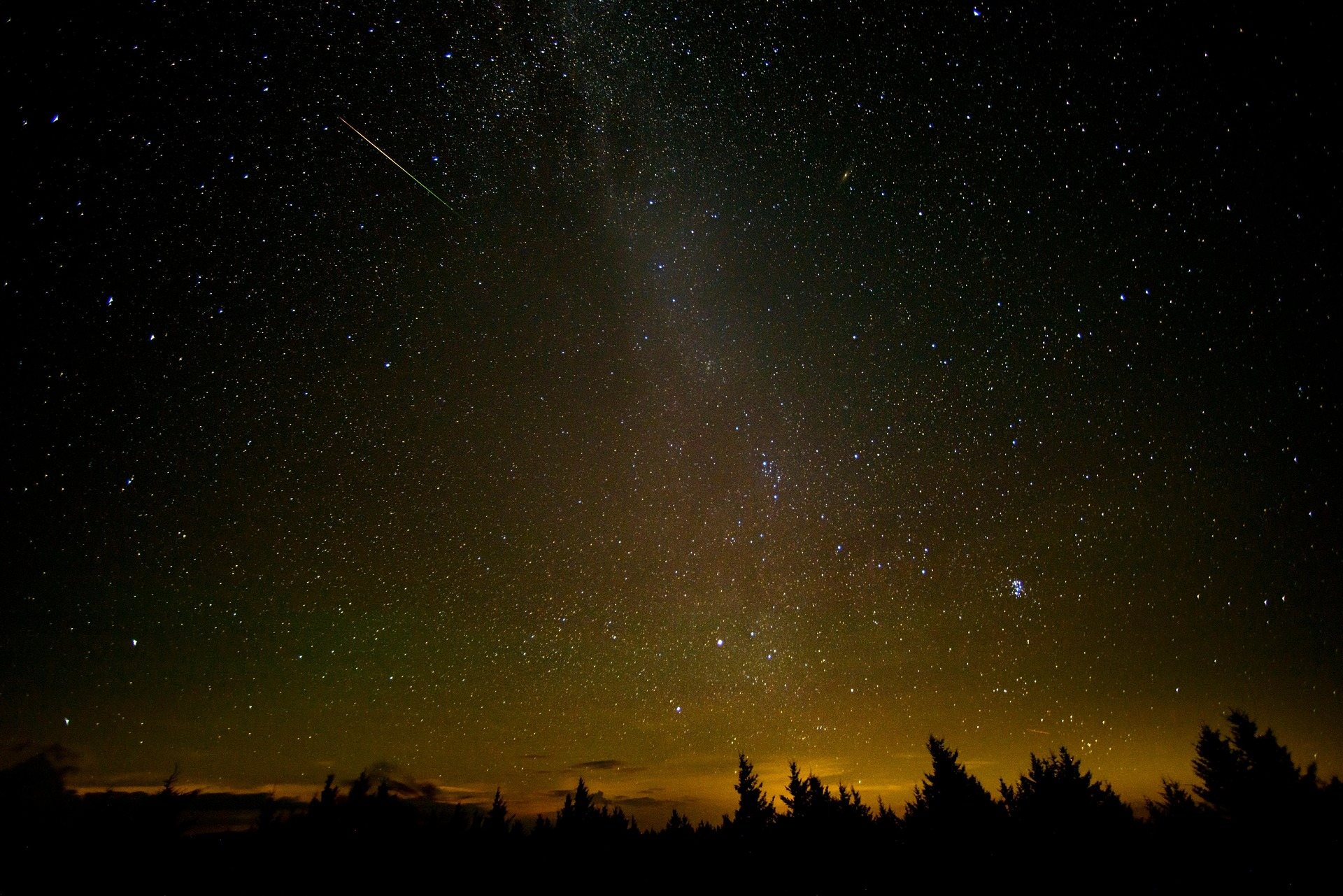
Stargazing and dark skies in West Virginia
Three International Dark Sky designations, all in one county, plus a 13,000-square-mile zone where radio silence is the law. West Virginia is one of the darkest places left in the eastern United States.
The interior of the state stays dark because so little of it is developed: few towns, few people and almost no city lighting for miles in any direction.
Between the Monongahela National Forest and the Allegheny highlands there are hundreds of square miles with no town large enough to throw a glow. Pocahontas County has gone further and had three of its public lands formally recognized as dark-sky sites, and the National Radio Quiet Zone around Green Bank Observatory suppresses not just radio but much of the development that usually follows a road.
Where to go
Watoga State Park
West Virginia's largest state park at 10,100 acres, and the state's center of gravity for dark-sky programming. The name comes from a Cherokee word meaning starry waters.
Cabins book roughly a year ahead. Hunting is not permitted inside the park, which makes autumn nights here easier than in the surrounding forest.
Calvin Price State Forest
The 9,482-acre state forest adjoining Watoga, and the least developed of the three designated sites. No facilities to speak of, which is part of why the sky over it is so dark.
Hunting is permitted here, unlike neighboring Watoga. Check WVDNR season dates before an after-dark visit in autumn or winter.
Droop Mountain Battlefield State Park
A Civil War battlefield on a ridge above the Greenbrier Valley, open around the clock, with a lookout tower and open ground that works unusually well for setting up a telescope.
Open all night, which very few West Virginia parks are. It hosts an annual star party — check the park calendar.
Green Bank Observatory
The first national radio astronomy observatory, founded in 1957, sitting inside a roughly 13,000-square-mile zone where radio transmission is restricted by law to protect the telescopes. The side effect is some of the least light- and radio-polluted sky in the eastern United States.
Grounds are free and open sunrise to sunset; the Science Center keeps its own hours. Expect little or no cell service — and do not treat the Quiet Zone as an absolute blackout either, since enforcement has relaxed over the years.
Spruce Knob
The highest point in the state at 4,863 feet, with a summit observation deck, a short paved loop and almost no development in any direction. Cold and exposed, with no shelter at the top.
The summit road is not maintained in winter. Nights here are far colder and windier than the valley forecast suggests.
Dolly Sods and Bear Rocks
Open heath barrens above 4,000 feet with no tree cover and no towns in the sightlines — the widest horizon-to-horizon sky in West Virginia.
Forest Road 75 is unpaved, rough and not winter-maintained. Navigating the plateau in the dark is genuinely serious — the trails are unblazed by wilderness policy.
Blackwater Falls State Park
Not a designated dark-sky site, but recommended by the state park system for stargazing and by far the easiest of these to reach with a lodge bed and a restaurant attached.
Dark enough for serious viewing, with cabins and a lodge on site.
Summersville Lake
Open water gives you an unobstructed southern horizon, which is hard to find in a state made of ridges. Best from a boat or one of the sandstone points.
Pair a July swim with a moonless night — the lake stays warm well after dark.
Getting a good night
Go near a new moon
A full moon washes out everything but the brightest stars. The few days either side of new moon matter more than which site you pick.
Give it twenty minutes
Dark adaptation is slow and one glance at a phone resets it. Use a red light, or none, and be patient.
Check the road, not just the sky
Forest Road 75 into Dolly Sods and the Spruce Knob summit road are unpaved and unmaintained in winter. A clear forecast does not mean a passable road.
Expect no signal
Much of this country has no cell coverage, and the Quiet Zone around Green Bank restricts transmission by law. Download maps and tell somebody your plan.
Cabins and campgrounds under dark skies
Placement for lodging within reach of a designated dark-sky site.
List your business here