
Every organization we link to: local tourism offices, the state and federal agencies that manage the land, the nonprofits and clubs that keep access open, and the universities doing the research.
West Virginia has roughly 1.5 million acres of public land and a handful of places that carry almost all of the attention. The consequence is that a great deal of very good ground sits nearly empty, usually for one of three reasons: nobody has heard of it, the road in is gated or rough, or it is undeveloped and has nothing to advertise. Those are the places below — of them across regions.
Almost Heaven Swings
The falls, the canyon and the ice
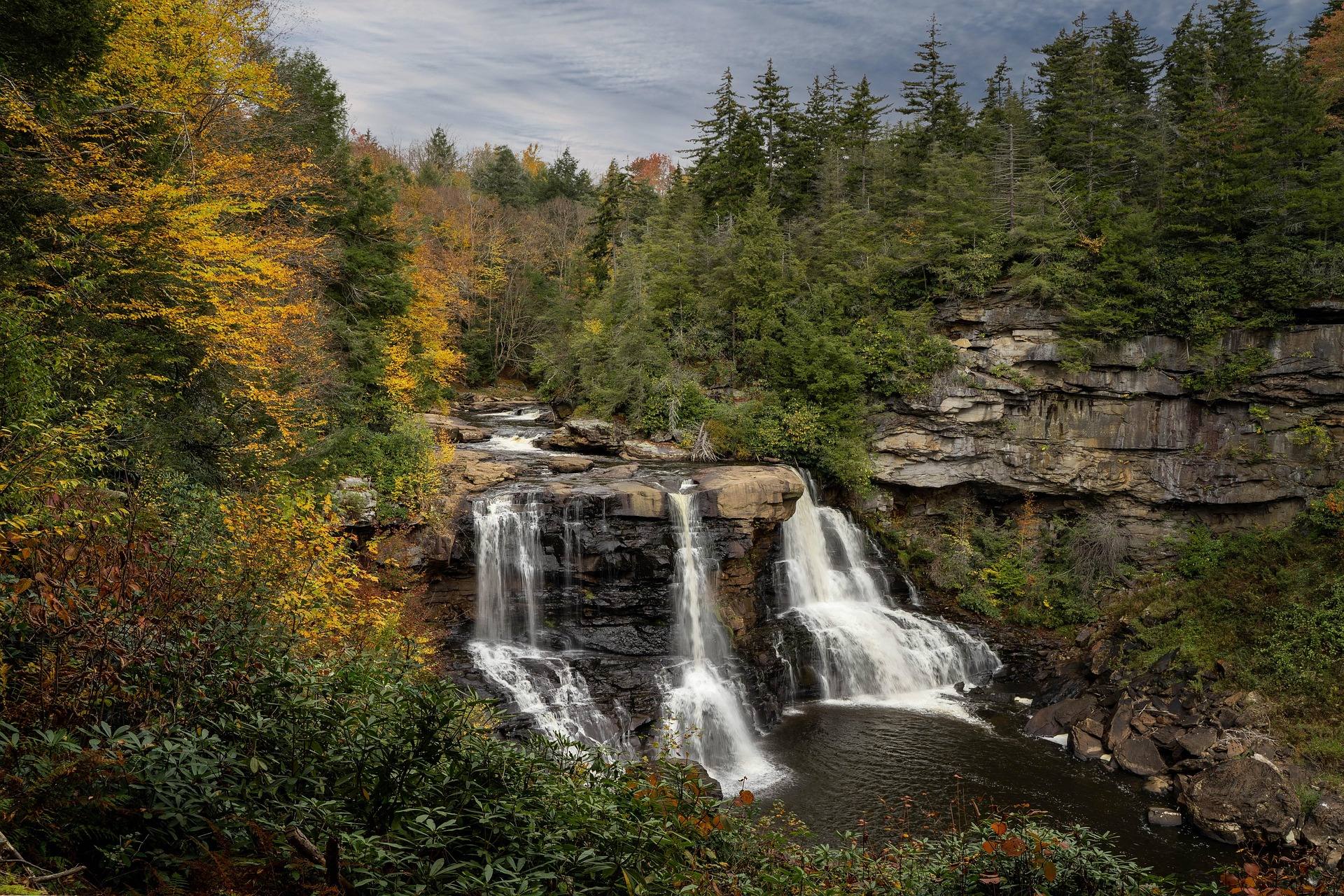
The Blackwater River drops 57 feet here and runs on into an eight-mile canyon below, its water stained amber by hemlock and spruce tannins. Boardwalk and stairs reach several viewing platforms above the drop. None of that changes with the season.
What changes is ice. The site's month-by-month reference names Blackwater Falls in ice as one of the great sights in the state, and it does so in the January to February entry, the same paragraph that has Canaan Valley, Timberline, White Grass and Snowshoe running. Winter is the season the reference singles this place out for.
Ice on one particular Saturday is still weather. The reference tells you which two months to aim at; the park office tells you what the falls looks like the day you arrive. The second question is a phone call rather than a search.
Why the snow belt decides your dates
Upslope snow is the mechanism behind all of it. Moist air forced up the Allegheny Front drops far more accumulation on Tucker, Preston and Pocahontas counties than on the surrounding region, and that is what creates the Canaan Valley snow belt. Valleys forty miles west can stay bare while the plateau runs deep.
First reliable snow reaches the snow belt in December, when the ski areas open. January and February are the settled part of the window, and the reference is direct that upslope snowfall in those counties regularly produces conditions nothing else in the mid-Atlantic can match.
November and early December are a different trip and still a good one. Leaves are down, views open up and trails empty out completely. If an unobstructed sightline into an eight-mile canyon matters more to you than snow underfoot, the bare weeks are the better bet.
Two ways down to the viewing platforms
A quarter mile of boardwalk and more than 200 steps take you down to the platforms. In summer that is a quick descent and a working climb back. In winter it is the same quarter mile of stair treads with snow and ice added as variables, and the park publishes no clearing policy for them.
The Gentle Trail is the paved quarter-mile route and it carries no stairs. It exists for anyone who cannot manage the boardwalk, and in cold weather that group is larger than usual. Take it without apology. It is a quarter mile to a view of the same 57-foot falls.
Those two routes are a small part of the network, since the park counts 21 trails in all. Which of them are broken out after a storm is a conditions question for the office.
Sledding, and what a winter day here costs
Sledders ride a magic carpet lift back to the top, which is what makes this the longest lift-served sledding run in the region and what makes a long session workable with small children. Nobody hauls a sled uphill between runs.
Holiday weekends sell out, so come midweek or book well ahead. Operating days depend on snow, which is where December matters: that is the month the site's reference puts first reliable snow into the snow belt, and the month the ski areas open.
On money: West Virginia charges no admission at any of its 35 state parks or nine state forests, and the policy is set in state code, so day use costs nothing here. Fees attach only to specific services, among them camping, cabins, lodge rooms and equipment rental, so ask the park what the sled run and any rented gear are priced at.
Lindy Point, Pendleton Point and Elakala
Lindy Point is 0.3 miles out to a rock outcrop the park puts at 3,000 feet, rated moderate to difficult, and it produces the state's best-known sunset photograph. Snow makes that third of a mile slower than the distance suggests, and the rating is the number to plan against.
Pendleton Point Overlook gives the deepest view down the eight-mile canyon. Elakala Falls sits a five-minute walk from the lodge and gets passed over by most visitors, which makes it the easiest thing on the property to add when the light starts going.
Sunset is the pivot of a short winter day, so work backward from it. Put the long stops early, keep Lindy Point for last, and carry a headlamp whatever the plan says.
Skis, snowshoes and the River Road grade
River Road Trail runs 1.56 miles on an old railroad grade linking the park to Davis, built to the gradient a railroad needed, and several of the park's other trails follow old grades as well. On skis or snowshoes that bench is the obvious line on the property.
The park publishes nothing about grooming, track-setting or rentals on its own trails. For nordic conditions in this snow belt the site points readers at White Grass Ski Touring, and at Timberline for the wider Canaan Valley picture. Canaan Valley Resort, not this park, is the one state park with lift-served downhill skiing.
On snowshoes the falls logic holds. The boardwalk's 200-plus steps are the hard way down and the paved quarter mile stays flat. Beyond those two, 21 trails and the 1.56-mile River Road grade give straightforward walking on snow.
Cold, driving and a bed for the night
Highlands weather is not valley weather. The site's safety reference has Dolly Sods and Canaan Valley running twenty degrees colder than the valleys, so carry insulation and a shell regardless of the forecast where you park. Allow more driving time than the map implies, since sixty road miles here can take two hours, and assume no cell service on the plateau.
Blackwater Falls is one of the state's resort parks, operating a full lodge and restaurant alongside its cabins. Cabin bookings open a year in advance, and this is one of the parks the reference names as filling within days of that window opening for summer and October weekends.
Camping appears on the park's activity list, though the record describes the lodge and cabins rather than campsites and gives no site count or winter season. State park campgrounds reserve through the state parks system, generally up to a year ahead, and dispersed camping is not permitted in state parks. Ask the office what is actually open in January.
Reach people planning this trip
Placement alongside guides for outfitters, guides, shops and lodging.
List your business hereQuestions
Does Blackwater Falls freeze in winter?
Is there an entrance fee at Blackwater Falls State Park?
Can you see Blackwater Falls without climbing all the steps?
When does the sled run at Blackwater Falls open?
Read next
Destination · Potomac Highlands
Blackwater Falls State Park
A complete guide to Blackwater Falls State Park: every waterfall and overlook, Lindy Point at sunset, the trails, lodging and the best season to visit.
8 min read · October Destination · Potomac Highlands
Things to Do in Davis and Thomas, West Virginia
A guide to Davis and Thomas, West Virginia: Blackwater Falls, Dolly Sods access, Canaan Valley skiing and two of the best small towns in Appalachia.
8 min read Guide · Potomac Highlands
Cross-Country Skiing at White Grass
How White Grass works: 50-plus kilometers on Cabin Mountain, why the upper trails hold snow, rentals and lessons, and where to ski when it turns thin.
7 min read · February