
Every organization we link to: local tourism offices, the state and federal agencies that manage the land, the nonprofits and clubs that keep access open, and the universities doing the research.
West Virginia has roughly 1.5 million acres of public land and a handful of places that carry almost all of the attention. The consequence is that a great deal of very good ground sits nearly empty, usually for one of three reasons: nobody has heard of it, the road in is gated or rough, or it is undeveloped and has nothing to advertise. Those are the places below — of them across regions.
Almost Heaven Swings
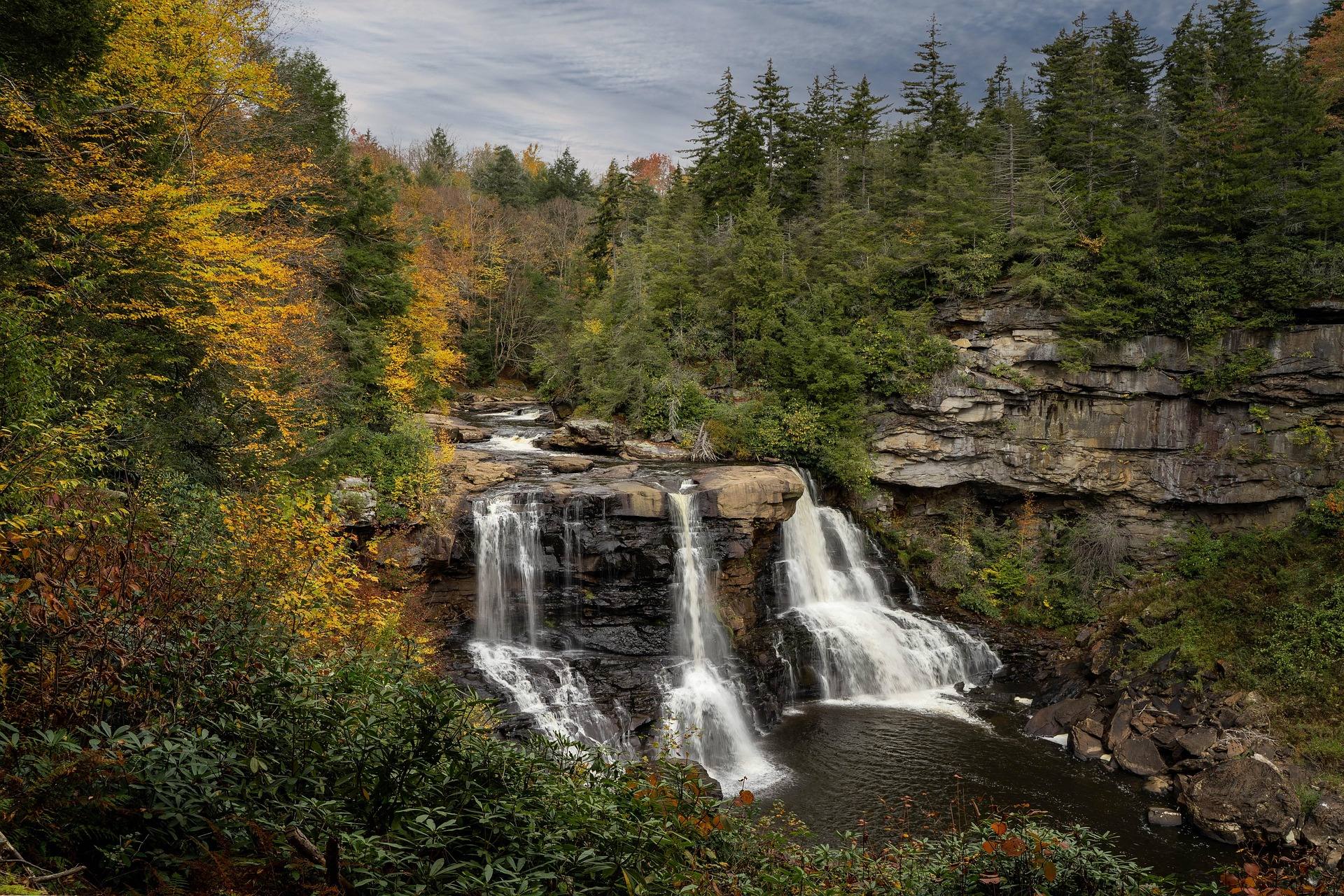
Why April gives the falls their weight
March and April are the high-water months. Snowmelt and spring rain put the Cheat, the Blackwater, the Meadow and every creek in the Highlands at their best, and that is the entire argument for a spring waterfall trip. Falls of Hills Creek is published as best in spring and after rain, in those words.
The same water carries costs. Trails are muddy, high-elevation trailheads may still be snowed in, and river levels change within hours of rain. Wildflowers do not really start in the coves until late April, so an early-April trip is about volume rather than green.
This is the private boater's season rather than the peak visitor season, which means falls trails are busy without being October-busy. Day use costs nothing at any of West Virginia's 35 state parks or 9 state forests, and no permit is required to hike Monongahela National Forest trails.
Falls of Hills Creek: three drops in three-quarters of a mile
Three waterfalls fall within three-quarters of a mile here, dropping 25, 45 and 63 feet. The lowest is the second-highest waterfall in West Virginia. The round trip is 1.6 miles, and everything you descend on the way in you climb again on the way out.
The trail to the upper falls is paved and accessible; past that it becomes steep stairs and boardwalk down into a mossy shale gorge. That arrangement makes the first waterfall a destination in its own right rather than a consolation, and it makes the lower two a stair workout when the rock is wet.
Shade and constant spray keep the gorge mossy, and that wet-rock plant community is as much the subject as the water is. Beyond the paved section, no grade or surface specifics are published, so ask the ranger district if you need them. Ice makes the winter descent dangerous, which is one more reason April beats February.
Blackwater Falls: amber water and more than 200 steps
The Blackwater River drops 57 feet into an eight-mile canyon, its water stained amber by hemlock and spruce tannins. The boardwalk to the falls is a quarter of a mile with more than 200 steps down, and the steps rather than the distance are what you will feel.
The Gentle Trail is the paved quarter-mile alternative for anyone who cannot manage stairs. Between the two, a 57-foot waterfall is reachable without a descent, which is unusual for a fall of that size anywhere in the state.
Elakala Falls is a five-minute walk from the lodge and gets passed over by most visitors, which in April, with the creek up, is an easy mistake to avoid. The park counts 21 trails in all, so the falls boardwalk is the start of the property rather than the whole of it.
The canyon rim: Lindy Point, Pendleton Point and the walk to Davis
Lindy Point is 0.3 miles, rated moderate to difficult, out to a rock outcrop the park puts at 3,000 feet above the canyon. It produces the state's best-known sunset photograph, and sunset is when to be standing on it.
Pendleton Point Overlook gives the deepest view down the eight-mile gorge. Neither overlook is a waterfall, but in April the canyon is running loud below both, and together they show you the drainage the falls belong to.
River Road Trail runs 1.56 miles on an old railroad grade and links the park to Davis at the gradient a railroad needed. It is the least strenuous walking on the property and the way to reach town on foot rather than by car.
Wet rock, high water and the April hazards
More people get hurt on West Virginia rivers than anywhere else outdoors in the state, and April is when levels move fastest. Check flow before you plan around a creek: the USGS real-time gauge network covers every gauged stream in West Virginia. Do not swim in water you have not inspected from the bank.
Spray-slick stairs and boardwalk are the actual risk at both of these falls. Take the descent at Falls of Hills Creek slowly, and treat the 200-plus steps at Blackwater Falls as the part of the walk that will tire you, since the mileage will not.
Blacklegged and lone star ticks are active in any month above freezing, and West Virginia has high rates of Lyme disease. Treat clothing with permethrin and check thoroughly afterward. Highlands weather also runs far colder than the valleys, so carry insulation and a shell whatever the forecast said at home.
Building an April waterfall weekend
Falls of Hills Creek sits in the Greenbrier Valley on the Monongahela National Forest; Blackwater Falls is a Potomac Highlands state park with a lodge and cabins. Sixty road miles between two points here can take two hours, because the roads follow creeks and ridges rather than straight lines. Check real drive times.
State park cabin bookings open a year in advance, and Blackwater Falls is one of the parks that fills for summer and October weekends within days of the window opening. April is easier. Camping appears on the park's activity list, but no site count or season is published for it, so ask the park about campground layout and reservations.
For closures and road status on the national forest side, Monongahela National Forest posts its own alerts. Davis sits at the far end of River Road Trail and is one of the state's trail towns, which makes it the practical base for the Blackwater half of a spring trip.
Reach people planning this trip
Placement alongside guides for outfitters, guides, shops and lodging.
List your business hereQuestions
When is the best time to see waterfalls in West Virginia?
How tall is Blackwater Falls, and how many steps are there?
Is there an accessible waterfall trail in West Virginia?
Do you have to pay to visit Blackwater Falls State Park?
Read next
 Best of
The Best Waterfalls in West Virginia
West Virginia's best waterfalls, from Blackwater Falls and Sandstone Falls to the Falls of Hills Creek, with access notes and the right season for full flow.
8 min read · April
Destination · Potomac Highlands
Blackwater Falls State Park
A complete guide to Blackwater Falls State Park: every waterfall and overlook, Lindy Point at sunset, the trails, lodging and the best season to visit.
8 min read · October Destination · Potomac Highlands
Things to Do in Davis and Thomas, West Virginia
A guide to Davis and Thomas, West Virginia: Blackwater Falls, Dolly Sods access, Canaan Valley skiing and two of the best small towns in Appalachia.
8 min read